
Anna Akhmatova
1889 - 1966

Anna Akhmatova was born the fourth of six children into an upper-class family. Her early years were spent at Tsarskoye Selo, an imperial summer residence north of St. Petersburg, which happens to also be where Alexander Pushkin attended school. Despite these luxuries, her childhood was marked by its own tragedy. During her adolescence, she attempted suicide following the dissolution of her family, which was plagued by illness and death, as well as her parents’ extramarital affairs. Nevertheless, Akhmatova emerged as a young woman who would become one of Russia’s most renowned modernist poets. Her writing for me exudes a particular femininity, a direct voice, unafraid to target its emotional core, that is extremely difficult to find when searching the depths of Russian Soviet-era art.
At the age of 23, Akhmatova published her first collection of poems, Evening. This marked the beginning of her literary life during what is often called Russia’s “Silver Age”—a period of intense creative blossoming that spanned the early 20th century. Throughout this time, Akhmatova was a shining light within literary circles and socialized with some of the most influential writers of the era, including Alexander Blok and Andrei Bely.
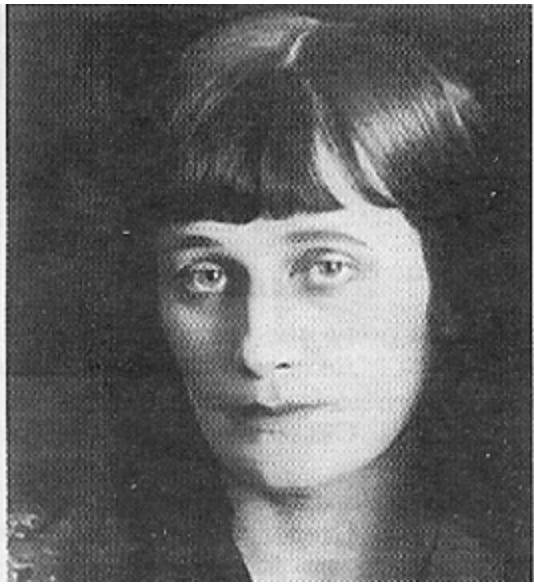
She was described by her friends as magnetic, mischievous, and deeply lovable; also as enigmatic and complex. She was known for being highly sensitive, often hysterical, neurotic, and a hypochondriac. These qualities added layers to her character and often made her difficult to understand. Standing at five feet eleven with thin, graceful features, long, straight black hair, and deep-set gray-green eyes, she was said to be a “mysterious beauty.” Of mixed heritage (Tartar, Greek, Ukrainian, and Russian), she adopted the surname “Akhmatova” after her Tartar grandmother. This was in response to her father’s teasing suggestion that she might tarnish his surname with her “lousy poetry.” Hmmm.
Akhmatova’s first admirer came at the age of thirteen, in the form of Nikolai Gumilyov, or Kolya. Their relationship was marked by the intensity of Kolya’s unrequited love, which led him to a suicide attempt on one occasion. Before agreeing to marry him, Akhmatova wrote to her brother: “I’m marrying the friend of my youth, Gumilyov. I believe I am fated to become his wife. Whether I love him or not, I don’t know, but I think I do”.
They did indeed end up marrying. In one of Kolya’s poems, he famously described Anna as “half nun, half harlot,” a phrase later used by the Stalin regime to describe her. Although this was intended as an insult, it also encapsulates the nuances of Akhmatova’s character, which of course contribute to the honesty of her poetry.
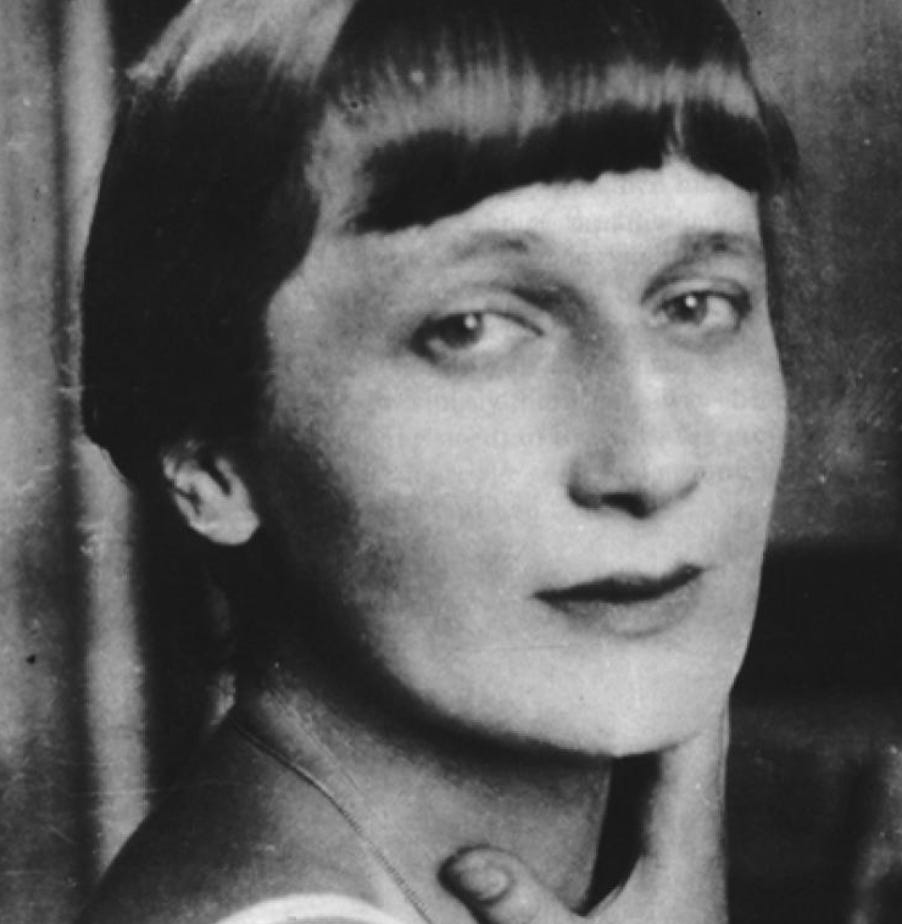
Gumilyov was executed by the Bolsheviks in 1921 due to his “counterrevolutionary conspiracies,” just a few years after their marriage, and this tragedy had a deep effect on Anna. Her relationship with the Soviet regime became tumultuous, and it is often said that she ceased writing poetry for thirteen years following his death.
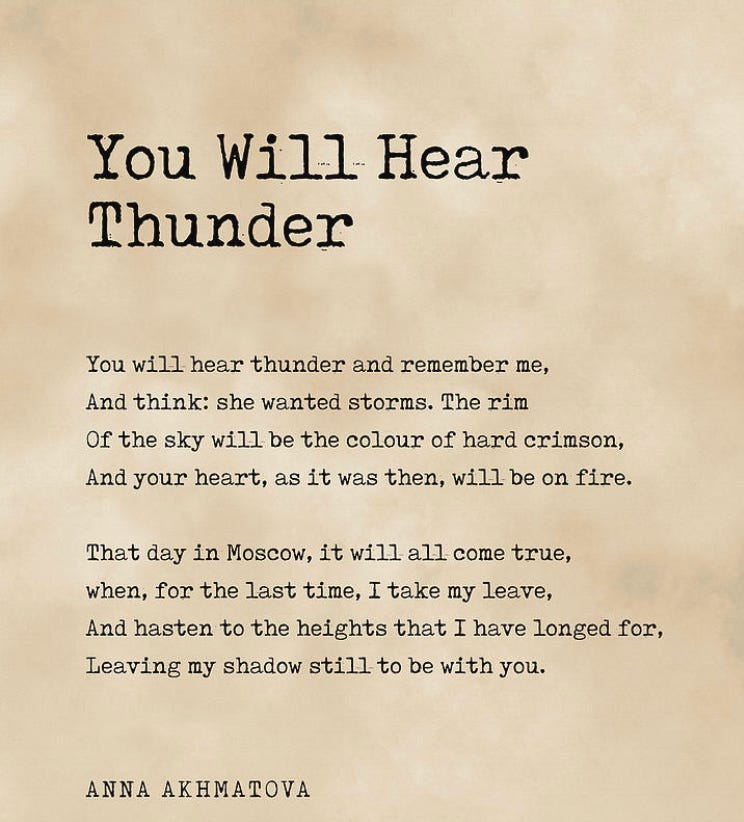
That was only the beginning. This struggle with the Soviet regime deeply shaped Akhmatova’s adult life. The Russian Revolution occurred when she was 28, and the Bolshevik censorship that followed severely impacted creativity in Russia. Akhmatova’s poetry, which often worked with questions of personal freedom, spiritual yearning, and the world of feeling, naturally faced harsh disapproval from Soviet authorities.
Now, the walls have come down, and her poetry dances more freely, able, perhaps, to do what poems have a sneaky ability to do: live out their trust task, far beyond the confines of time.
Bibliography
Davies, J. Anna of All the Russias: The Life of Anna Akhmatova. Lincoln Davies & Co, Liverpool, 1988.