
Angels, Angles, and Anguish
An Ordinary Benediction

Sometimes I speak words to an empty room. This is a test. I work to gauge the temperature of the room—the substance of space—by forming words into it. Some call this talking to oneself. But for me, this is the ultimate attempt to reach beyond myself, to what must be present beyond my own figure, past my own form. I test the waters of space to sense what lives around the imminent, tethered, angular me.
I am not used to being answered. I think very few of us are. We, especially young people, ask a whole lot of questions and revert to living them out, in hopes of the proverbial answer. This endurance can last a lifetime, if luck abides. But answers come slim, uncontoured, and sometimes affection-less.
I am not used to being met. I can shake many hands a day, if I make that an intention. I can look into many eyes. I can talk. But that moment of taking true interest in the other, and receiving genuine attention in return, grows considerably rare as I tread through time. Yet we cultivate social life daily. We even have media for being social. Gosh, we are really trying to meet each other!
I speak, I speak, do you hear it?
I am not used to listening beyond sound. I relish my own voice; we all do. I invoke sound because sound gives space a substance. Musicians know this deeply. But there is a sound that exists in time, too. Silently. Often in between the “Hello, how are you” and the “I’m good,” there is a profound word made of something entirely else.
This “not being used to” is why I sometimes address the spiritual world as loudly as I can. With anguish and integrity. I seek not a response, but responsibility. I know there is a kinship between me and the unseen, a tending. I find ultimate attention, where reality is something that can be attended. I recover a listening beyond sound, because obviously an empty room cannot be heard.
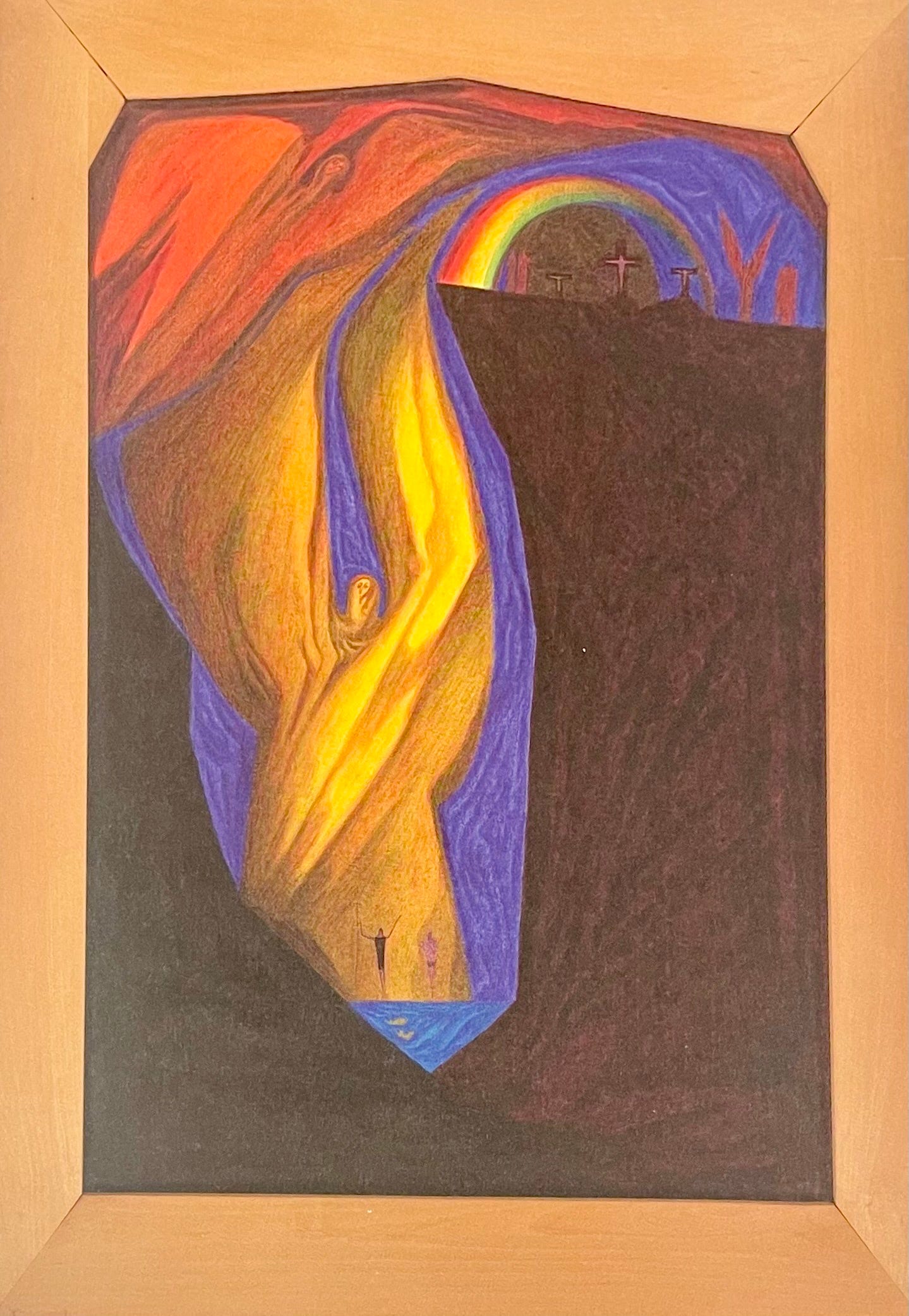
Angels are not super popular today. Modernity has made them corny. As a child, I was led to experience my angel as a creative force that worked in a realm we term “play.” As an only child, I played with my angel, essentially. And that was normal. But as my friendships deepened, I began to have playdates in social spaces that were lively, but distanced me from the primal source of my higher self. This was the first death-process in my life. The wisdom of my angel fled as I landed in the playground, on the swing, in the classroom. I shouted in games.
At the dawn of my twenties, I experienced the next death-process, where the fervent activity of my inner-life mellowed into stoicism—a more moderated, assimilated, social self. Oh angel, who are you then? Who are you in adulthood?
I think every “adult” can remember that they were once guided, and in some sense, being only in my mid-twenties, I am still held by something within the empty room. Something that knows me. I remain partially recognizable. But the angles of the walls grow tighter around me. I am sure all “adult” readers know this confinement. Geometry tightens through living. The finite grows evermore perceptible. One wrangles space into infinity, shoving it about in hopes of initiation.
I await that next death-process, where new life must ignite within me, if I am to bring anything fresh to this world. Hence, the speaking to an empty room. The wielding of intentional words, of meditative selfhood, to force myself, somehow, back into the spiritual world.
Methodologies, throughout life, can remain childish. We ruffle that well-known creative impulse of childhood, just as a junky scrunches up his sleeves to receive a fix. Yet biography must be transformation. It must be reintegration with angelic beings, not as pupils, but as colleagues.
This methodology is not something I know. I still speak in sound. But there are moments of communion, where I am granted participation in the creation of the world. This rarely happens with other human beings. That is the tragedy of not yet knowing how to truly enter the social, relational sphere. It can feel so fake there; so often phony. But this is the striving: to turn my anguish, my speech, into a lens through which to act. Not hastily, not childishly, not with detachment, but with complete entrance.
Can you hear me in this empty room? I am more monk than I know. So are you. Our cells breathe. May language find its liturgy. May we all find literacy in listening. May liminality unfurl its wings.