
Alexander Vvedensky
Futurist Poet

Born in 1904, Alexander Vvedensky lived a short but intense life, dying in 1941. He was a prolific poet who, to this day, is often tragically overlooked.
Vvedensky grew up around the liberal intelligentsia of St. Petersburg, in the heat of the Bolshevik Revolution. In his early adulthood, he worked as a researcher at the State Institute of Artistic Culture, focusing primarily on Futurist abstract poetry. (Futurism, as a literary form, came about out of the modernist impulse to merge art with politics and technology. It tried to prepare for the dawning of a new era.) Shortly after this, he became a prominent figure in underground avant-garde groups, where his poetry was celebrated for its complex, seemingly abstract but demanding political symbolism.
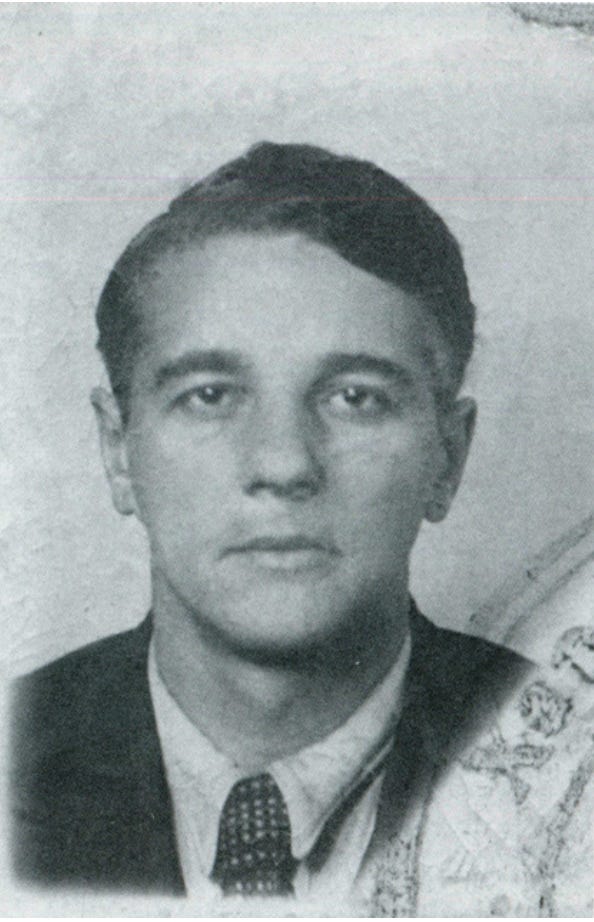
He was, like most interesting artists during Soviet times, unable to publish his work. It was deemed detrimental to the “good of the state,” too strange, and dangerously complex. Instead, he made his living by writing children’s literature. Nevertheless, in 1931, he was arrested for his alleged “counterrevolutionary” literature and sentenced to three years of exile. Ten years later, he was detained once more and ultimately died from an inflammation in his lungs while on a prison train.
Unfortunately, much of Vvedensky’s work remains undiscovered and is likely lost. What we can read, however, shows us that his work is of high value, should not be overlooked, and offers a unique and startling commentary on life in the USSR.
The main reason the Soviet regime censored Vvedensky’s work was its complexity. The State wanted literature, as well as all art in general, to be “understandable” to the masses. This resulted in most Soviet-approved literature as mere “reflections” of reality—at least the accepted reality of day-to-day Soviet life—and a general disdain for anything abstract or “avant-garde.” This left no room for Vvedensky’s work. The degree to which his poetry is not understandable made him a direct threat to the Soviet way of life. For example, in his poem-play called “The Mirror and the Musician,” he writes:
“You God are ill
you sphere are thin
fat fleas cause
itch of the skin
O lord of lords we are offended
resentment hath our necks distended”
This reflects a direct disdain for authority, or a certain kind of authority. albeit abstractly.
Vvedensky’s poetry offers a radical commentary on the apocalyptic nature of the first half of 20th century Russia. War, revolution, regime, propaganda, and death orbited his youth. For this simple fact alone, his work should not only be studied but taken as something like an artist’s creed—promoting the creative spirit over the iron grip rigid indoctrination.
I recommend reading An Invitation for Me to Think. Eugene Ostashevsky and Matvei Yankelevich provide the best translations.